The most important part of any video ad is the first 3 seconds. A video ad script that converts stops the scroll with a visual or verbal hook, names the viewer's specific problem by the 7-second mark, and ends with one action, not three. Most businesses spend their budget getting the production right and never fix the script, which is why their ads get views but not clicks.
Quick Summary
- The hook (first 3 seconds) determines whether anyone watches the rest of your ad
- A proven video ad script structure is: Hook, Problem, Solution, Proof, Call to Action
- Write for sound-off viewing: over 80 percent of Meta videos are watched without sound
- Keep scripts to 15 to 30 seconds for Meta and TikTok; up to 60 seconds for YouTube pre-roll
- AI video production lets businesses test two or three script variations at a fraction of the traditional cost
- Mystudionet Productions, based in West Babylon, Long Island, handles scripting through final delivery for businesses across Nassau County, Suffolk County, and New York City
Why does the script matter more than the production budget?
A polished video with a weak script will underperform a rough video with a great script every time. The script is the strategy: it decides who you are talking to, what problem you are solving, and what you want the viewer to do next. Production quality raises credibility once someone is already watching. The script is what gets them watching.
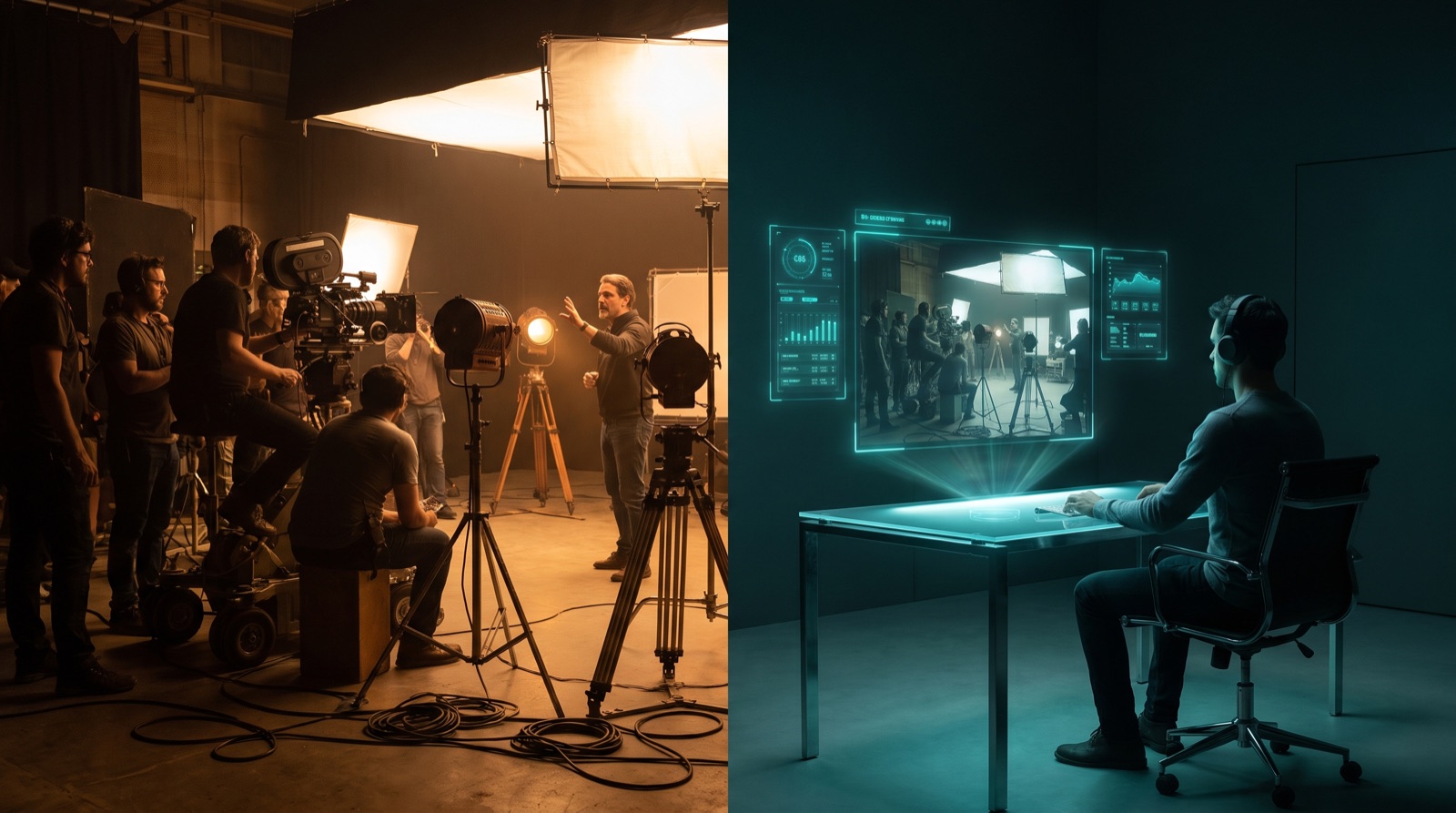
This is also the reason why AI video production has made scripting more valuable, not less. When production costs drop from tens of thousands of dollars to a few thousand, the creative and strategic work in the script becomes the main competitive advantage. See how much an AI commercial costs in 2026 to understand how much budget is freed up for iteration.
What is the structure of a high-converting video ad script?
The five-part framework below works across Meta, YouTube, TikTok, and LinkedIn. Every section has a job to do.
1. Hook (0 to 3 seconds) Your one task is to interrupt the scroll. The hook is a bold visual, an unexpected statement, or a direct question that speaks to the viewer's situation. "Still paying for TV commercials?" works for a business owner. "Your product launch video is costing you sales" works for an e-commerce brand. The hook is not an introduction. Do not open with your logo or your company name.
2. Problem (3 to 7 seconds) Name the pain clearly. The viewer should feel that you understand their situation before you pitch anything. "Most small businesses waste 40 percent of their video budget on footage that never gets used" is a problem statement. "We help businesses grow" is not.
3. Solution (7 to 15 seconds) Introduce your product or service as the answer to that exact problem. Be specific. "We produce AI-powered video ads in under two weeks, at a fraction of traditional production cost" is specific. "We make great videos" is not.
4. Proof (15 to 22 seconds) One piece of evidence: a before-and-after, a result, a testimonial clip, or a visual demonstration. Proof does not need to be lengthy. A single strong visual or one-sentence stat is enough to move a skeptical viewer.
5. Call to Action (last 3 to 5 seconds) One action only. "Book a free discovery call" beats "visit our website, follow us on Instagram, and subscribe to our newsletter." Tell viewers exactly what to do and why to do it now.
How long should a video ad script be for Meta, YouTube, and TikTok?
Platform rules are not suggestions. A 90-second ad that would perform on YouTube will bleed on Meta.
- Meta (Facebook and Instagram Reels and Stories): 15 to 30 seconds is the sweet spot. Aim for 15 if you are running Stories. The hook must work without sound because most viewers have audio off.
- TikTok: 15 to 30 seconds for awareness, up to 60 seconds if the content is genuinely entertaining. Native-feeling content (not polished ads) outperforms broadcast-style production here.
- YouTube pre-roll (skippable): You have 5 seconds before the viewer can skip. The hook must earn the next 5 seconds. A 15 to 30-second ad that cannot be skipped is fully watched; a 60-second ad is fine if the product needs demonstration.
- LinkedIn: 30 to 60 seconds works here because the audience is in a professional context and more tolerant of information-dense content.
For businesses running ads on multiple platforms, the most efficient approach is to write one master script in the 30 to 45-second range, then cut it down to 15 seconds and adapt hooks per platform. This is one of the reasons video marketing strategy for small businesses in 2026 recommends producing one core video before making platform cuts.
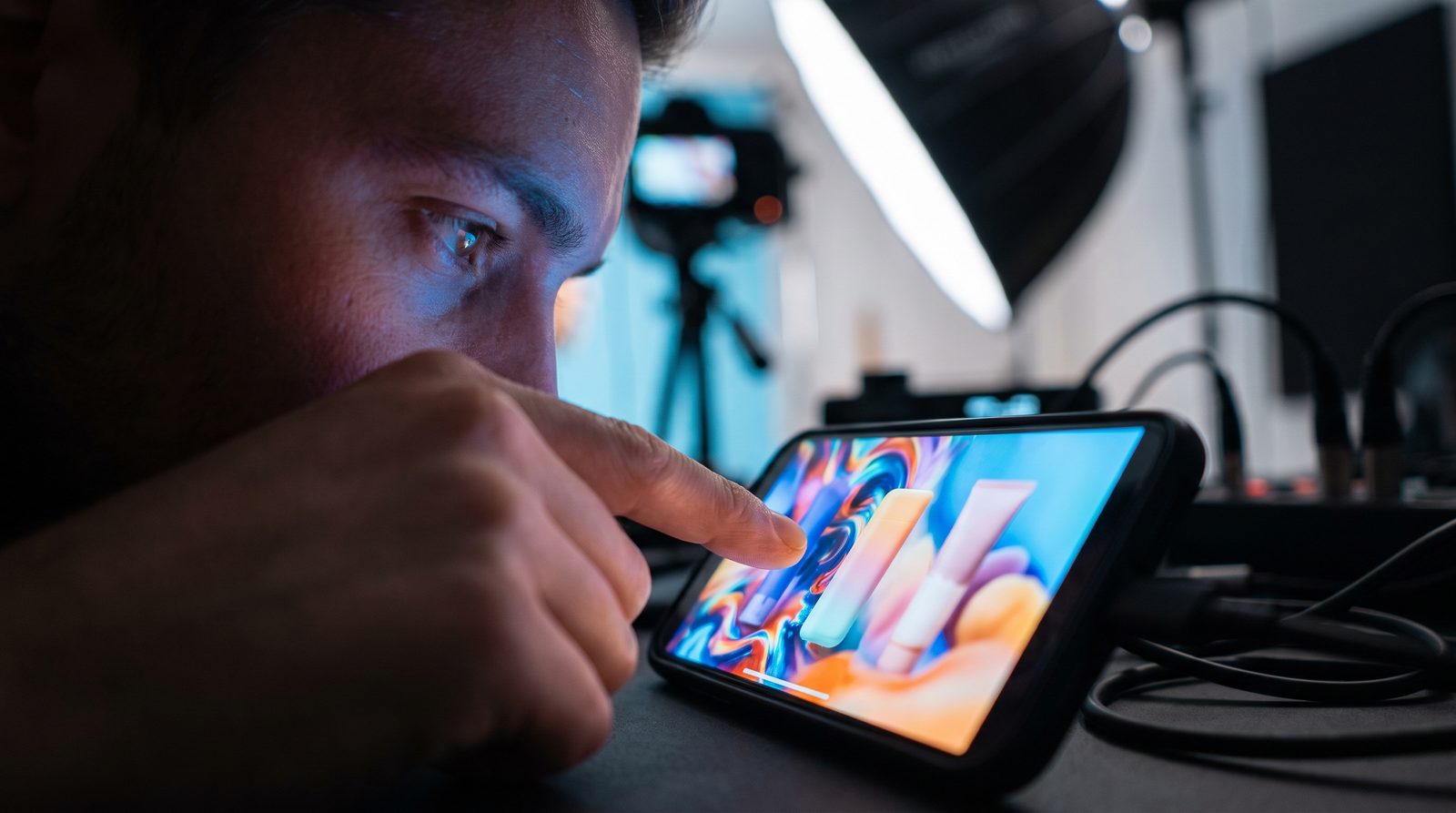
Testing your ad on a phone before publishing shows you exactly what viewers see
What are the most common video ad script mistakes businesses make?
These five mistakes appear in most underperforming business video ads:
- Opening with the company name or logo: Viewers do not care about your brand name yet. Earn their attention first.
- Trying to say everything: One ad, one message, one CTA. A video that mentions your three services, two promotions, and website address will be remembered for none of them.
- Writing for sound-on viewing: If your ad only works when someone is listening, you are losing the majority of your audience. Every key message should be readable as text on screen or visible in the action.
- Vague problem statements: "Looking to grow your business?" is so broad it means nothing to anyone. "Running paid ads that get clicks but no sales?" speaks to a real person with a real problem.
- Weak or absent CTAs: "Learn more" is not a call to action. "Book your free 30-minute strategy call this week" is. Specificity increases clicks.
How does AI video production change the scripting process?
AI production dramatically lowers the cost of testing multiple scripts. In a traditional shoot, you commit to one script because a full day of crew time costs $5,000 to $20,000 before post-production. With AI video, you can produce two or three variations of the same 30-second ad, each with a different hook, for a fraction of that cost, and run them against each other in the first week of a campaign.
Mystudionet Productions builds this testing mindset into every AI commercial project. Rather than betting on a single creative execution, we produce a primary version and one or two hook variations, then let real ad performance data drive the next round. See how this works in our AI-powered production service.
This also changes the revision process. Because there are no location fees or crew day rates, adjusting a line of dialogue, swapping a scene, or changing the CTA in post-production is relatively fast. Clients who brief us on a clear script from the start still move faster, but the cost of a script change after production is much lower than it would be on a traditional shoot.
Frequently Asked Questions
How many words should a 30-second video ad script be?
A 30-second video ad script is typically 60 to 90 words when spoken at a natural pace. Read your script aloud at the speed you want it delivered and time it: this is the most reliable way to check length. Scripts that feel short on the page often run long on camera.
Should a video ad script have a voiceover or on-screen text?
Both approaches work, but your choice should match your platform and audience. Voiceover tends to work better on YouTube and connected TV where sound-on viewing is more common. On Meta and TikTok, on-screen text captions are essential because most viewers scroll with sound off. Mystudionet Productions always delivers both options: a captioned version for social and a clean version for broadcast.
Can I use the same script for Meta ads and YouTube ads?
You can use the same core script but the hook needs to be adapted. Meta requires a hook that works without sound and grabs attention in the first 2 to 3 seconds of an autoplay feed. YouTube pre-roll gives you 5 seconds before a skip option appears, so the hook must be strong enough to earn 5 more seconds. The problem, solution, and CTA sections can stay consistent across platforms.
How many rounds of revisions are typical for a video ad script?
Most projects at Mystudionet Productions go through two to three rounds of script revisions before production: one round on the initial draft, one round after client feedback, and a final pass once the structure is locked. This is significantly faster than iterating on a produced video because changing words costs nothing. Get the script right before the cameras roll.
Is it worth hiring a professional to write a video ad script?
Yes, especially if you are spending money to run the ad. A poorly scripted ad wastes your entire media budget because clicks and impressions mean nothing if the ad does not hold attention. Professional scriptwriting for a single 30-second video ad typically costs a few hundred to low four figures as a standalone service. Many video production studios, including Mystudionet Productions, include scripting in the production package.
Get Your Video Ad Script and Production Done Right
A great script is the foundation of every high-performing video ad. Once the strategy is locked, production is the next step. Mystudionet Productions, based in West Babylon, Long Island, handles scripting, AI production, and platform delivery for businesses across Nassau County, Suffolk County, and Greater New York City.
Book your free 30-minute discovery call to talk through your video ad idea, or email info@mystudionet.com.